Start-ups in 2026 function in a world where speed, scalability, and reliability are key determinants for success. Whether it is cloud-based services and financial technology apps or AI-based offerings and e-commerce brands, today’s start-ups depend quite heavily on information technology infrastructure that can scale without denting their wallets. With cloud prices soaring and managing and running their own infrastructure becoming increasingly complex, start-ups today are opting for data center colocation hosting services.
Data center colocation hosting provides a sweet spot for startups, catering to their needs while being equally adept at balancing control, performance, and cost-effectiveness. Rather than setting up their own centers, startups opt to locate their servers in well-facilitated centers equipped with power, cooling solutions, security, and premium connectivity. The approach seems to prove itself a well-informed decision for infrastructure investments in 2026.
The Infrastructure Challenge for Startups in 2026
Modern-day startups have certain infrastructural hurdles to overcome. Scaling at a rapid pace requires enhanced availability and low latency. Security and compliance have become stricter than ever before. Simultaneously, one must be mindful of CAPEX and avoid technology lock-in.
So, traditional infrastructure requires a large initial outlay of capital for hardware, electricity, cooling, and personnel. The cloud offers flexibility. But its unpredictable cost, network capacity, and performance can be quite challenging for a startup company’s budget. This marked contrast between control and budgeting needs is exactly what data center colocation hosting can address.
What Is Data Center Colocation Hosting?
Best Colocation hosting within a data center allows a startup company to maintain its own servers and networking equipment within a professionally operated data center. In a colocation hosting arrangement, a hosting company provides the infrastructure, such as power distribution, cooling systems, fire suppression systems, and security, as well as connectivity. However, the startup company maintains complete control over its equipment.
Most colocation facilities in 2026 are operating as Tier III or Tier IV data centers, providing high availability, redundancy, and carrier-neutral connectivity. That way, it ensures a startup receives an enterprise level of infrastructure without having to build it themselves.
Scalability Without Heavy Capital Investment
One of the biggest reasons startups choose colocation data center hosting is due to scalability. As startups grow, their infrastructure requirements rapidly change in a short amount of time. Colocation allows businesses hosting to scale server capacity, bandwidth, and power usage incrementally without having to make large upfront investments.
They could start with a single rack or a partial rack and scale up according to demand. This pay-as-you-grow model helps in conserving cash flow while supporting rapid expansion. In 2026, this will be extremely important for a startup that operates in competitive and fast-moving markets.
Cost Control and Predictable Expenses
Cloud solutions seem attractive from a cost point of view initially, but as you utilize them further, they can incur substantially higher expenses as a result of data transmission charges. Data center colocation hosting will incur fixed expenses per month.
However, by owning the hardware and paying flat rates for space, power, and connectivity, a startup has more control over expenses. In the long run, hosting their applications on a colocation facility becomes even cheaper than using a public cloud for high-traffic applications since a startup grows in size.
Enterprise-Grade Security and Compliance
Security is a very crucial consideration, especially in start-up companies that handle sensitive user information, financial transactions, and intellectual technology. Modern data centers in colocated facilities have multi-layered security systems, which entail biometrics and man traps.
Apart from the traditional concerns for physical security, the data centers also adhere to global standards such as ISO, SOC, or PCI DSS. These global standards make it simpler for startups to adapt to the regulatory norms. In the year 2026, the aspect of compliance readiness will no longer be optional for healthtech, SaaS startups, or fintech.
High Availability, Redundancy, and Uptime
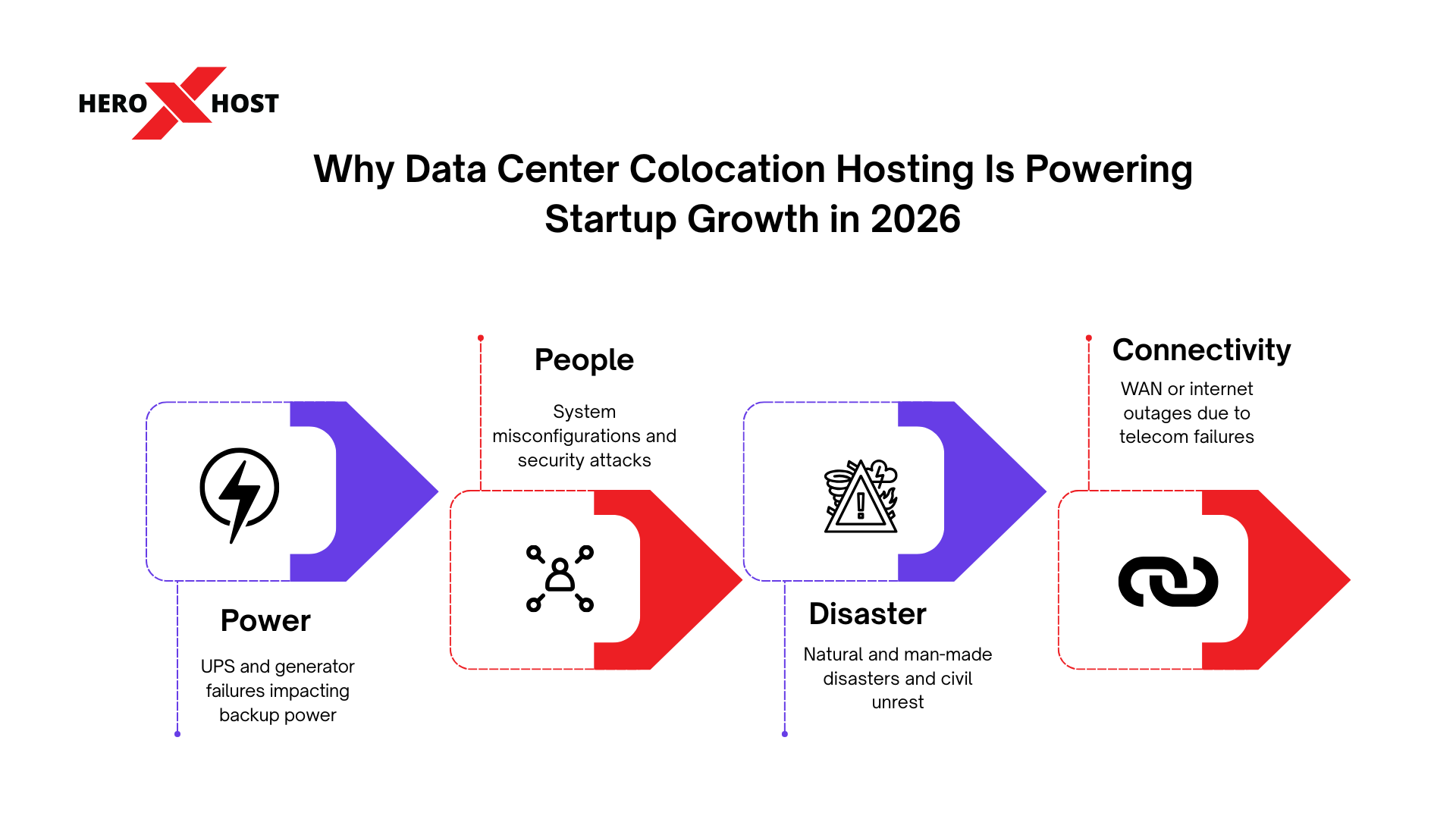
Downtime can be very detrimental to the profitability of a startup business. Data center colocation hosting provides high levels of availability in terms of power supplies, generators, and cooling systems, as well as various paths.
Tier III & IV host facilities are built to continue to function even in the event of hardware failure or a hardware upgrade. Such high availability ensures that startups have the ability to maintain consistent user experiences.
Performance, Low Latency, and Network Control
Performance is another significant strength of data center colocation web hosting. Colocation facilities are usually built in hubs that are well connected to a variety of internet service providers. This neutral network connectivity of colocation facilities is crucial as it allows startups to have better performance of applications.
Start-ups Performing latency-intensive services such as analytics, online games, video streaming, and machine intelligence can benefit from the kind of networking control that colocation data centers can provide. Performance optimization has a direct role in the usage experience and conversion rates for users in 2026.
Supporting Hybrid and Multi-Cloud Strategies
Modern startups rarely rely on a single infrastructure model. Many adopt hybrid or multi-cloud strategies to balance flexibility, resilience, and cost efficiency. Data center colocation hosting integrates seamlessly with public cloud platforms, acting as a stable foundation for hybrid architectures.
Startups can keep core workloads in colocation while using cloud services for burst capacity, backups, or global reach. This approach reduces vendor lock-in and improves overall infrastructure resilience, making startups more adaptable to future changes.
Ideal for High-Growth Startup Use Cases
Colocation hosting in the data center is especially well-suited to start-ups in industries like SaaS, fintech, e-commerce, gaming, AI, and IoT. All these industries demand high performance, robust security, and predictable costs.
As the amount of data grows along with the number of users, colocation allows the necessary stability to be able to innovate and quickly develop products. In 2026, investors also see sound infrastructure planning as a mark of maturity.
How to Choose the Right Colocation Data Center
Choosing the right data center partner is essential to ensuring startup success. Variables that must be considered when choosing data centers are tier, geographical location, connectivity to networks, scalability, security, and service level agreements. Startups must also assess remote hands services, cross-connect availability, and expandability.
A well-chosen colocation data center thus becomes an infrastructure partner to the growth of the start-up from the early stages to the corporate phase.
Conclusion
In 2026, start-ups require infrastructure that is able to keep pace with the dynamism of innovation, growth, and a heightened level of consumer demand. The power of scalability, cost control, security, and optimal performance lies in the ability of a data center colocation hosting provider to drive the growth of a start-up. In this way, the start-ups provide a competitive advantage to their business by utilizing the large enterprise-grade data centers without having to establish their own data centers. Because of the dynamic nature of the demand for technology, colocation of the data centers acts as a future-proof hosting solution for the owners of the start-up ventures.
Frequently Asked Questions (FAQs)
1. What is data center colocation hosting?
Ans. Data center colocation hosting lets startups place their own servers in a secure, enterprise-grade data center with managed power, cooling, and connectivity.
2. Is colocation hosting suitable for early-stage startups?
Ans. Yes, it offers scalability, security, and performance without the cost of building in-house infrastructure.
3. How does colocation hosting help startups reduce costs?
Ans. It provides predictable pricing and eliminates expenses related to power, cooling, and data center maintenance.
4. Is data center colocation hosting more secure than cloud hosting?
Ans. Yes, it offers enterprise-level physical security while giving startups full control over their hardware and data.
5. Which startups benefit most from colocation hosting?
Ans. SaaS, fintech, AI, gaming, and e-commerce startups benefit the most from its performance and reliability.