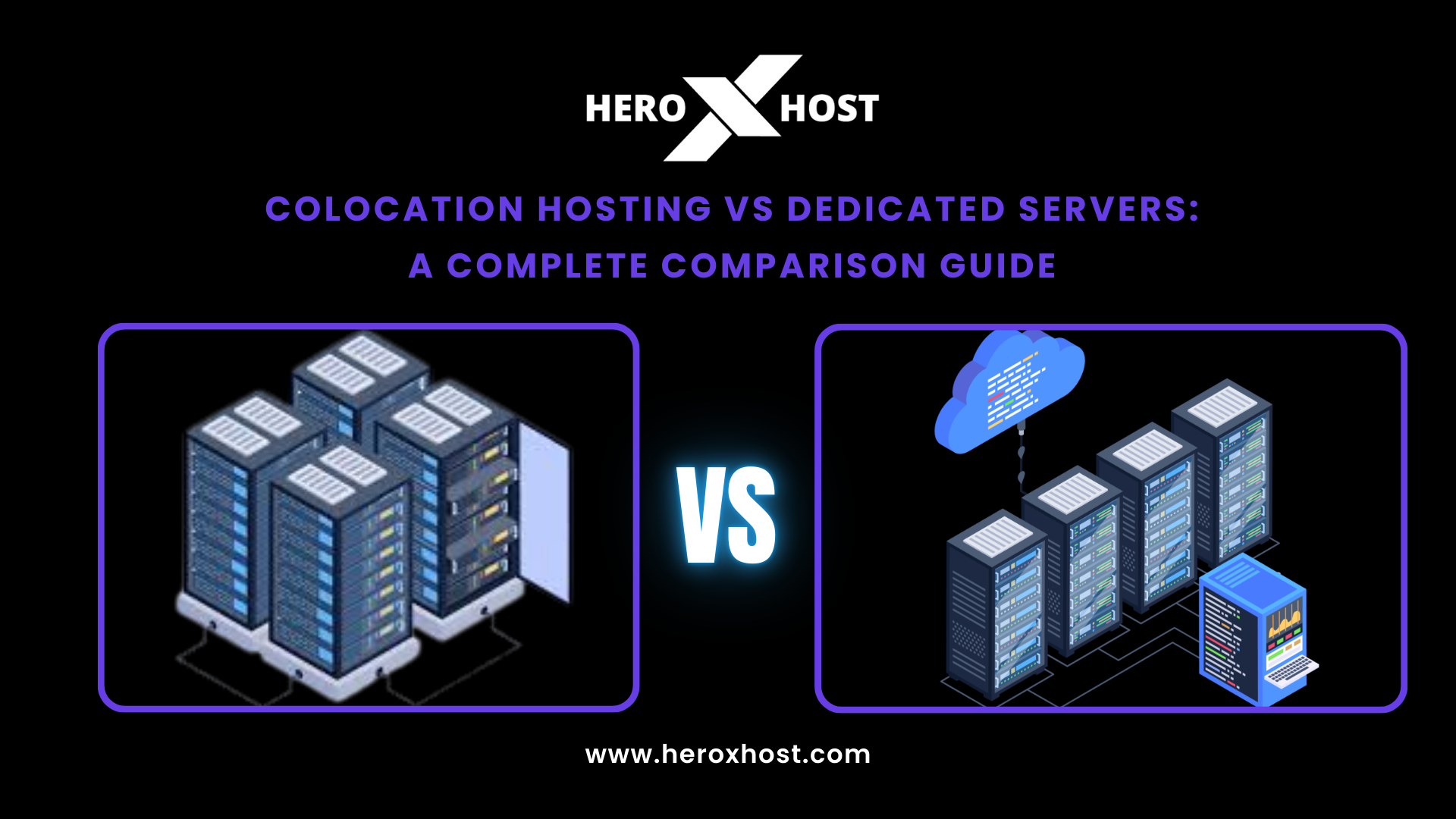
Choosing the right hosting infrastructure is one of the most critical decisions for growing businesses in 2026. Performance, security, scalability, and long-term cost efficiency all depend on whether your infrastructure aligns with your business needs. Among enterprise-grade hosting options, colocation hosting and dedicated servers stand out as two powerful yet fundamentally different solutions. Though both offer top-notch performance and reliability, they are meant for different purposes. This guide will offer information on the differences, which will allow you to pick the one confidently.
Understanding Basics of Colocation Hosting
Affordable colocation hosting is an arrangement where the business maintains its own server but houses it in a third-party facility. Rather than locating their server infrastructure in an office or in-house server room, the business uses the facilities provided by a colocation facility that include power infrastructure, cooling infrastructure, networking infrastructure, and security infrastructure. However, the business maintains complete control over the infrastructure and software.
This type of model is often utilized by organizations that have their own enterprise-level servers or require a completely customized hardware configuration. Colocation gives organizations the possibility of avoiding an immense upfront capital cost of setting up a data center while having complete control over their infrastructure.
Understanding Dedicated Servers
Dedicated servers operate on a leasing model where a hosting provider owns the physical server and rents it exclusively to a single client. Unlike shared hosting or VPS solutions, all server resources are reserved for one business, ensuring consistent performance and high reliability. The provider handles hardware procurement, maintenance, and replacements, while customers focus on operating systems, applications, and workloads.
Dedicated servers are suitable for small businesses that require high performance without resorting to managing servers or dealing with hardware. They offer a convenient solution that balances control and manageability and are therefore suitable for small businesses or high-traffic sites.
Differences in Ownership and Control
Among the main differences that exist between colocation web hosting and dedicated servers is the actual ownership of the infrastructure. In a colocation facility, the business owns all of the equipment outright and has the ability to use the servers and storage and other networking components in any way they see fit.
In contrast, dedicated servers can offer administrative control without administrative responsibility and hardware without hardware ownership. While the client has the ability to set up the software environment and the usage of resources, hardware configurations are only possible if they are available through the service provider.
Performance and Reliability Comparison
Both colocation hosting and dedicated servers deliver high performance, but the way performance is achieved differs. Colocation performance depends heavily on the quality of the owned hardware and network design. Since businesses choose their own components, they can build extremely powerful systems optimized for specific workloads. Reliability is enhanced by enterprise-grade data center infrastructure, including redundant power supplies and cooling systems.
Dedicated servers offer more stable performance, as the configuration is set by the server provider. The components are also replaced if they go bad, with the provider promoting a certain level of uptime with their service level agreement. Dedicated servers are more stable than shared servers for a firm that lacks in-house expertise in hardware.
Security Considerations
Security is one key consideration in making a choice between colocation hosting services and dedicated servers. In colocation hosting services, physical security is very high because data centers employ biometric security access and restricted access areas. In this case, computer security concerns such as firewalls and patch management remain the responsibility of the business.
Dedicated servers also operate in secure data centers, but many providers add network-level protections such as DDoS mitigation and managed firewalls. This makes dedicated servers easier to secure for companies without dedicated cybersecurity teams. Both solutions can meet strict compliance standards, but colocation requires more hands-on management.
Scalability and Growth Potential
Scalability is critical for any business that plans to grow over a period of time. Colocation hosting allows businesses to scale up by upgrading hardware, adding more racks, or increasing bandwidth connections. Inasmuch as this provides deep customization, scaling could take some time because of the need to procure hardware and install it.
Dedicated servers scale up much faster because businesses can upgrade plans or deploy additional servers easily. If hardware is needed, it’s all taken care of by the hosting service provider. Therefore, dedicated servers are most suitable for fast-growing businesses without any delay in flexibility.
Cost Structure and Long-Term Investment
However, the cost structure varies greatly when it comes to colocation hosting services and dedicated hosting solutions. In colocation hosting services, capital expenditure has to be incurred on server acquisition, in addition to operational costs related to the rack space consumed by the server, its power consumption, and bandwidth. Though the initial expense incurred is high, the end results may be cost-effective.
Dedicated servers follow fixed rates every month with regard to server usage, power consumption, and maintenance. Although this reduces capital expenditure, this solution might prove to be costly in comparison to server leasing when considering usage periods.
Maintenance and Operational Responsibility
Colocation hosting places most operational responsibility on the business. Hardware failures, upgrades, and replacements must be handled internally or through paid remote-hands services. This model works best for organizations with in-house IT teams and advanced infrastructure knowledge.
Dedicated servers significantly reduce operational burden. Providers monitor hardware health, replace failing components, and ensure physical uptime. Businesses can focus on application management rather than physical infrastructure, which is a major advantage for teams with limited technical resources.
Network Connectivity and Bandwidth
Another domain in which the hosting of colocation has turned out to be very good is network flexibility. In fact, enterprises are free to connect to a number of internet carriers, make network paths redundant, and optimize routes for traffic with high performance on different parts of the globe. This level of control is ideal for enterprises handling large volumes of data or latency-sensitive applications.
Dedicated servers usually come with preset bandwidth amounts and network configurations set by the provider; although these will suffice for most applications, they are not quite as customizable as colocation environments.
Ideal Use Cases for Colocation Hosting
Colocation hosting is best suited for enterprises that require maximum control, custom hardware configurations, and strict compliance requirements. Organizations running mission-critical applications, private cloud platforms, or proprietary software stacks benefit greatly from colocation. It is also ideal for businesses that already own servers and want to reduce infrastructure relocation costs.
Ideal Use Cases for Dedicated Servers
Dedicated servers are ideal for organizations that require high performance without unnecessary complexity. Some of the most common uses include websites, SaaS platforms, e-commerce storefronts, and other content-heavy applications. Organizations looking for ease of deployment and predictability of costs, along with managed support, may view dedicated servers as the most sensible choice.
Choosing Correctly in 2026
The choice between hosting colocation and a dedicated server depends on your priorities in business. If ownership, customization, and network control are paramount, then colocation hosting can’t be beat. If management ease, fast scalability, and operational simplicity are more important, then a dedicated server is a compelling, efficient solution.
Final Conclusion
Both colocated hosting and dedicated servers are high-end hosting options for performance-centric businesses. Colocation provides ultimate control and long-term efficiency for organizations with technical know-how, while the case is different with dedicated servers, which offer convenience, reliability, and faster scalability. Understanding your workload needs, budget, and internal capabilities will set you on the right path to choosing the solution that supports 2026 and beyond in terms of sustainable growth and operational stability.
Frequently Asked Questions (FAQs)
1. In what respect is colocation hosting different from dedicated servers?
Ans. Colocation entails owning a server, while dedicated hosting entails renting a server from a hosting service.
2. What type of hosting provides more hardware control?
Ans. With colocation hosting, the host has full control over the hardware.
3. Is it more convenient to run dedicated servers than colocation hosting?
Ans. Dedicated servers are easier to manage compared to virtual servers since the provider is responsible for maintaining the servers.
4. Which one would be more economical?
Ans. Colocation might be a more economical solution in the long run when hardware is properly optimized.
5. Is colocation hosting beneficial for small businesses?
Ans. However, the service that is most appropriate for organizations that have technical capabilities and require stable infrastructural support is colocation.